Energy Security
Energy security is an important component of national security, particularly in times of increasing global instability. In terms of electrical power generation, energy security includes both control over the energy source and the infrastructure to convert the source to electricity. Energy sources that are within the borders of a country have a preference over those that are subject to trade agreements and long-distance transport. Canada is fortunate to have hydraulic, hydrocarbon, uranium, solar, wind, and geothermal resources within its borders. The challenge is more the limited availability of indigenous infrastructure supply.
Canada has significant engineering and construction capability to develop hydraulic generation infrastructure and the components can be sourced from a relatively wide range of mostly foreign suppliers. Unfortunately, most of Canada’s easily accessible hydraulic resources have already been developed. Wind and solar are intermittent and depend on a limited range of suppliers from foreign countries, some of which may not have interests aligned with Canada’s. Canada has the capability to design and construct hydrocarbon generating stations and component supply is fairly broad based. However, these facilities are greenhouse gas emitting and are more appropriate as peak demand facilities to limit emissions. Canada has an in-depth capability and supply base for nuclear generation, particularly CANDU type PHWR systems.
Nuclear generation based on PHWR systems is highly domestic, particularly when fuelled by Canadian natural uranium. The reactor refit technology builds on this advantage. Many of the components are similar to those on existing CANDU stations and can be supplied by the same suppliers. Components that are based on new materials have at least two sources of supply from countries that historically have had good alignment with Canada, namely the United States, Japan and Germany. If demand is sufficient, there will be opportunities to localize the manufacturing to Canada.
The refitted reactors would initially be fuelled by a combination of natural and slightly enriched uranium fuel. The capability to manufacture the natural uranium fuel in Canada is well established. Enriched uranium fuel would rely on foreign enrichment facilities that exist in a number of countries which are well aligned with Canada. It is anticipated that with operating experience, adjustments to fuel and fuel channel components can be made to permit the refit reactor to be fuelled entirely with natural uranium fuel.
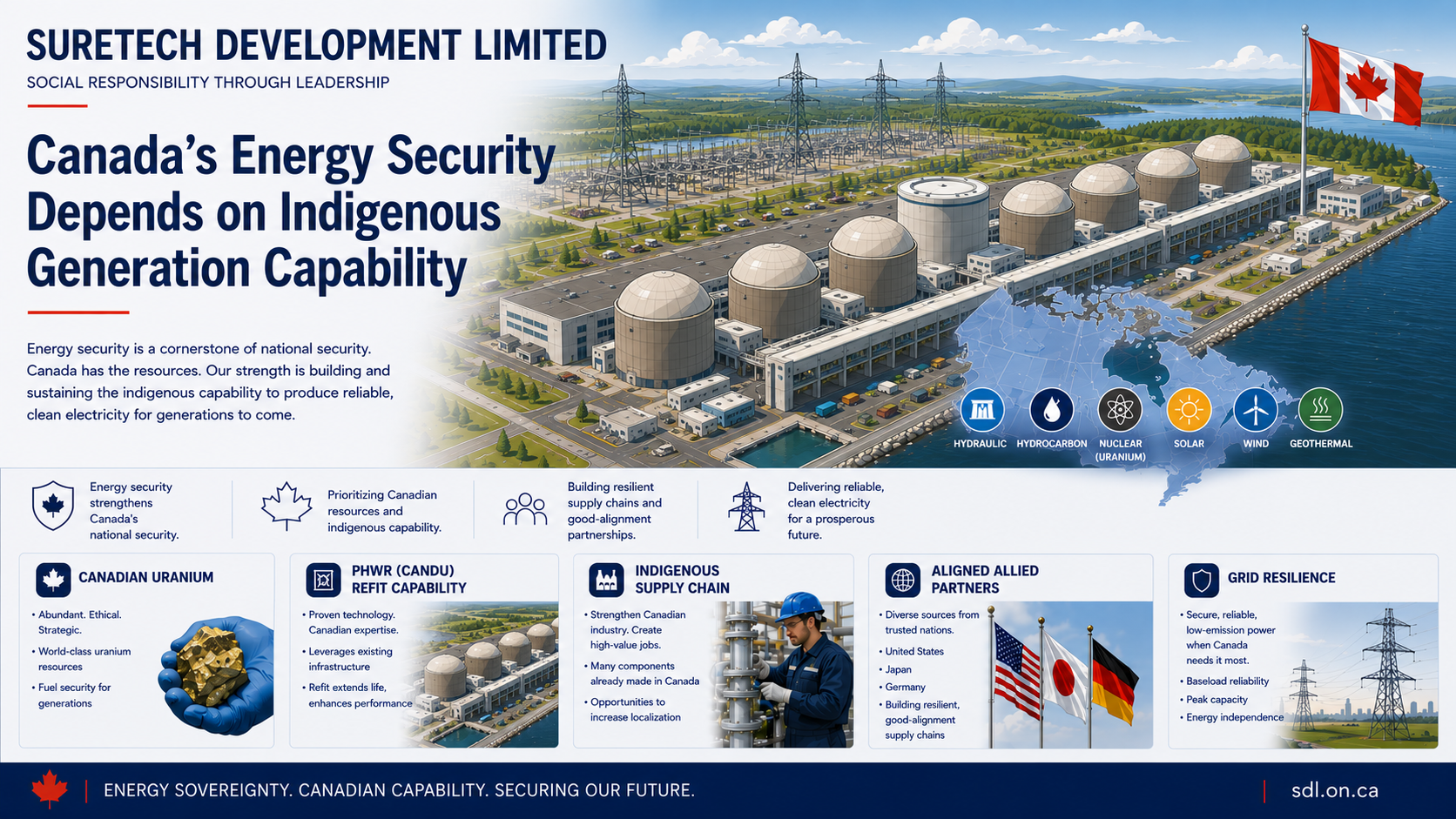
Click image to enlarge.
Energy Security Highlights
- Control over the energy source and the infrastructure to convert the source to electricity.
- Canada has hydraulic, hydrocarbon, uranium, solar, wind, and geothermal resources within its borders.
- Canada has an in-depth capability and supply base for nuclear generation, particularly CANDU type PHWR systems.
- The reactor refit technology builds on this advantage.
- With sufficient demand, there will be opportunities to localize manufacturing to Canada.